Architecture Overview
iso8583sim is designed with a focus on performance, extensibility, and ease of use.
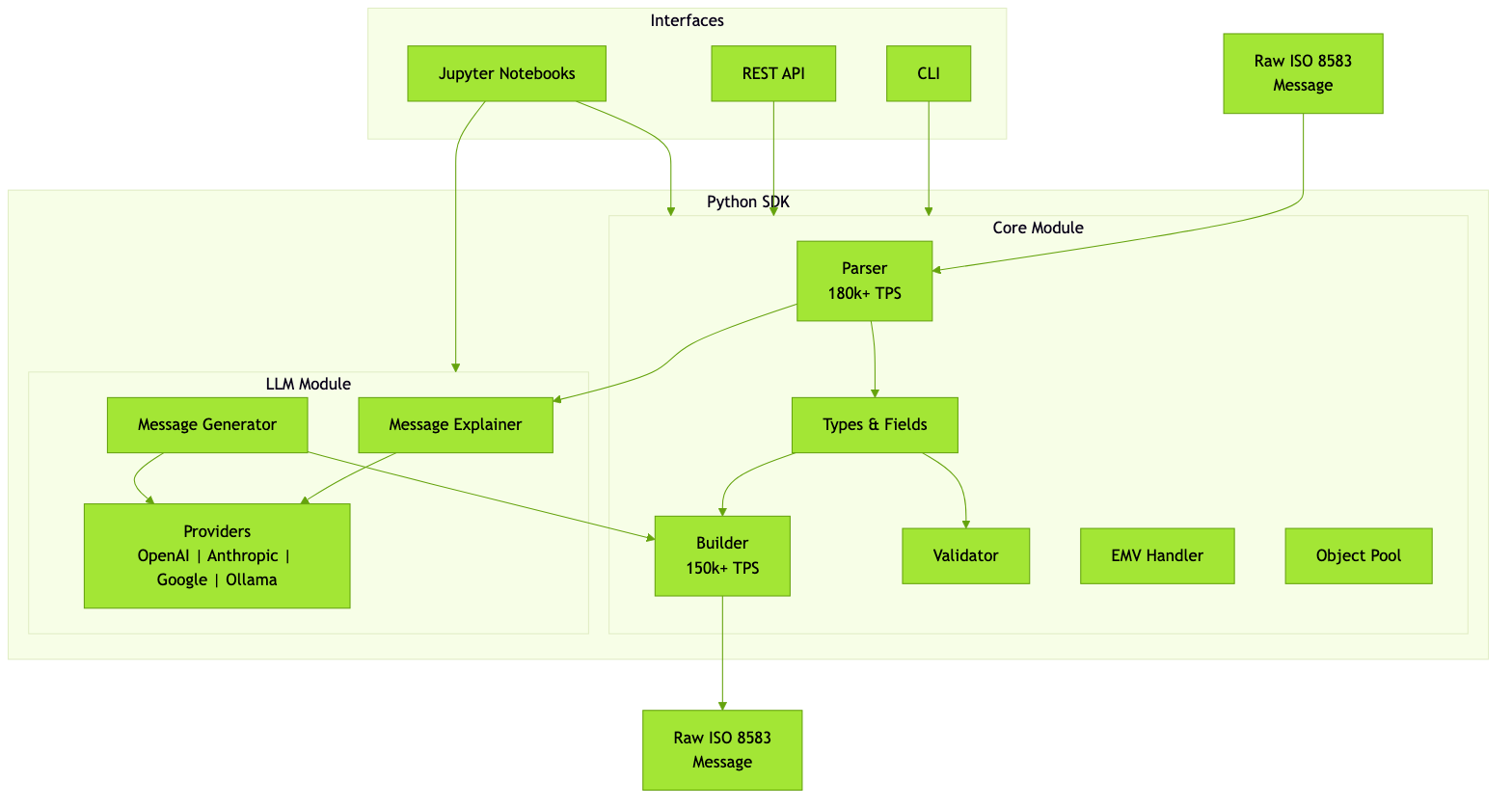
Design Principles
1. Network-Agnostic Core
The core parsing and building logic is network-agnostic. Network-specific handling (VISA, Mastercard, etc.) is layered on top through:
CardNetworkenum for network identificationNETWORK_SPECIFIC_FIELDSfor network-specific field definitionsNETWORK_REQUIRED_FIELDSfor network validation rules
2. Performance First
Performance optimizations include:
- Optional Cython extensions: 2x speedup for parsing operations
- Object pooling: Reusable message objects for high-throughput scenarios
- Pre-compiled regex patterns: Avoid recompilation overhead
- Cached field lookups: Network and version-specific field caching
3. Optional LLM Integration
LLM features are completely optional:
- Core functionality works without any LLM dependencies
- Provider-agnostic design supports Anthropic, OpenAI, Google, Ollama
- Auto-detection of available providers based on installed packages and API keys
Package Structure
iso8583sim/
├── core/               # Core message handling
│   ├── types.py        # Data types, enums, field definitions
│   ├── parser.py       # Message parsing
│   ├── builder.py      # Message building
│   ├── validator.py    # Message validation
│   ├── emv.py          # EMV/TLV data handling
│   ├── pool.py         # Object pooling
│   └── _*.pyx          # Cython extensions (optional)
├── llm/                # LLM-powered features
│   ├── base.py         # Provider interface
│   ├── explainer.py    # Message explanation
│   ├── generator.py    # Message generation
│   └── providers/      # LLM provider implementations
│       ├── anthropic.py
│       ├── openai.py
│       ├── google.py
│       └── ollama.py
├── cli/                # Command-line interface
│   └── commands.py     # Click-based CLI commands
├── web/                # REST API (future)
└── demo.py             # Interactive demo helpers
Key Components
ISO8583Message
The central data structure representing a parsed or constructed message:
@dataclass(slots=True)
class ISO8583Message:
    mti: str                                    # Message Type Indicator
    fields: dict[int, str]                      # Field number -> value
    bitmap: str = ""                            # Primary bitmap (hex)
    secondary_bitmap: str | None = None         # Secondary bitmap
    network: CardNetwork | None = None          # Detected card network
    version: ISO8583Version = ISO8583Version.V1987
    raw: str = ""                               # Original raw message
    emv_data: dict[str, str] | None = None      # Parsed Field 55 EMV data
ISO8583Parser
Stateful parser that converts raw message strings into ISO8583Message objects:
- Auto-detects card network from PAN prefix
- Supports ISO 8583 versions 1987, 1993, 2003
- Handles primary and secondary bitmaps
- Parses LLVAR/LLLVAR variable-length fields
- Optional Cython acceleration
ISO8583Builder
Constructs raw ISO 8583 message strings from ISO8583Message objects:
- Validates messages before building
- Handles field formatting (padding, length prefixes)
- Builds bitmap from present fields
- Network-aware field formatting
ISO8583Validator
Validates message structure and field content:
- MTI validation
- Field type validation (numeric, alpha, alphanumeric, binary)
- Network-specific required field validation
- PAN Luhn check validation
EMV Handling
Field 55 (ICC Data) contains EMV chip card data in TLV format:
parse_emv_data(): Parse TLV bytes into tag dictionarybuild_emv_data(): Build TLV bytes from tag dictionary- Support for multi-byte tags (9F26, 9F27, etc.)
Data Flow
See Message Flow for detailed data flow diagrams.
Extension Points
Adding New Card Networks
- Add enum value to
CardNetwork - Add field definitions to
NETWORK_SPECIFIC_FIELDS - Add required fields to
NETWORK_REQUIRED_FIELDS - Add validation method to
ISO8583Validator
Adding LLM Providers
- Implement
LLMProviderinterface - Add provider to
_PROVIDERSregistry inproviders/__init__.py - Implement
is_available()function
Custom Field Definitions
from iso8583sim.core.types import FieldDefinition, FieldType

custom_field = FieldDefinition(
    field_type=FieldType.ALPHANUMERIC,
    max_length=20,
    description="Custom field",
    field_number=120,
)